In the first five years after menopause, a woman loses approximately thirty percent of her dermal collagen. That statistic is usually quoted in cosmetic-industry press releases and then never followed up on, because following up on it would mean admitting that the supplement shelf at the drugstore is not the intervention the number demands.
Collagen is a protein. Eating it does not get it into your skin. The amino acids are digested, disassembled, and then used by whichever tissue is currently calling for them — which, in a forty-eight-year-old's body, is more likely to be gut lining or muscle than dermis. There is some evidence that collagen peptide supplementation produces a modest effect on skin elasticity in some women. There is much more evidence that the effect is small and that it does not address the actual mechanism of post-menopausal dermal collapse.
What is actually happening to the skin
Estrogen is one of the primary upstream regulators of dermal collagen synthesis. Fibroblasts — the cells that produce collagen — have estrogen receptors. When estrogen falls, fibroblast activity drops, collagen production slows, and the existing matrix is broken down faster than it is replaced. This is why skin change accelerates at perimenopause rather than progressing linearly from your twenties. The curve has a knee in it, and the knee is hormonal.
The second thing that happens is a loss of glycosaminoglycans in the dermal layer — the hyaluronic acid and related molecules that hold water and give skin its plumpness. This is also estrogen-regulated. And the third is a slowing of the vascular network that feeds the skin, which reduces oxygen and nutrient delivery to fibroblasts that were already working less hard.
All three are upstream of anything a drugstore cream or an oral collagen powder can touch.
Why copper peptide research is interesting
GHK-Cu — a short tripeptide bound to copper — has one of the longest research histories of any compound in the cosmetic-biology literature. It was first identified in the 1970s as a tissue-remodeling factor found in higher concentration in young plasma than in older plasma. Since then, it has been studied for wound healing, collagen stimulation, elastin synthesis, hair follicle signaling, and antioxidant activity in the dermis.
What makes GHK-Cu different from the rest of the skincare canon is that it doesn't behave like a passive moisturizer or an occlusive agent. It behaves like a signal. It interacts with fibroblasts, with the extracellular matrix, with copper-dependent enzymes that regulate tissue remodeling. The research describes it as a remodeling cue — a molecule the body recognizes as a message to rebuild.
It does not replace estrogen. Nothing over-the-counter does. But it is one of the few compounds in the literature that is plausibly addressing a layer below the topical cosmetic shelf — one that may matter specifically in the window where estrogen's signal has faded.
What the research does not say
GHK-Cu is not a clinical treatment for menopause. The peer-reviewed human skin trials are mostly small, cosmetic-industry-funded, or limited to specific endpoints like wound repair in controlled conditions. The in vitro literature is strong. The in vivo literature on post-menopausal women specifically is thin. Anyone telling you otherwise is selling something.
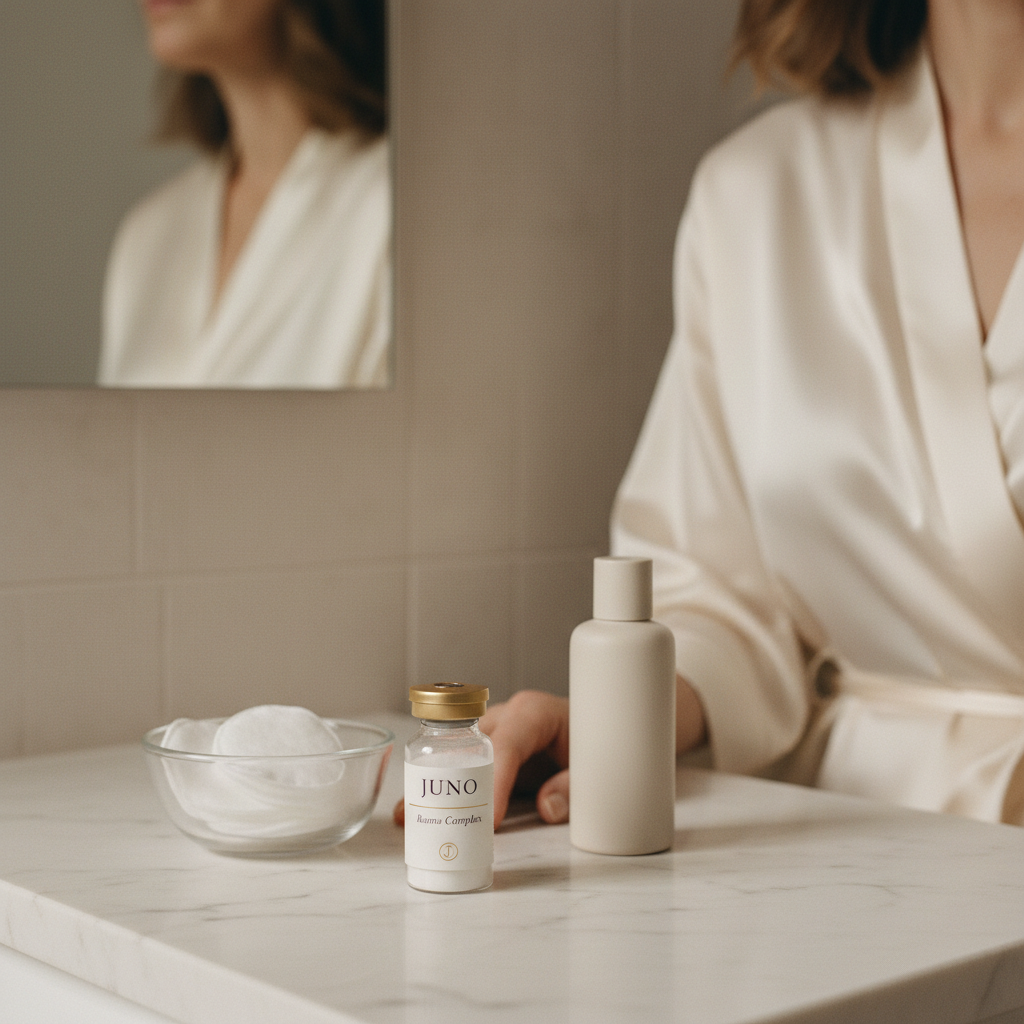
That thinness is exactly the reason Juno frames it as a research compound, not a finished skincare product. Renew is sold as reference material. It comes with its HPLC and mass spec. The research context is included. What you do with that context is a question for you and the literature — not a claim we make on your behalf.
The honest position
Collagen supplements are not harmful. They also are not the answer to a 30% collagen loss driven by hormonal decline. If you are in the perimenopausal or post-menopausal window and you are reading your own skin biology carefully, the research directions worth knowing about are upstream of the drugstore shelf: copper peptides, retinoid-class topicals, estradiol therapy in consultation with a qualified physician, and the general signal-quality work of sleep and resistance training that supports fibroblast function systemically.
"GHK-Cu behaves like a signal. It interacts with fibroblasts, with the extracellular matrix, with the copper-dependent enzymes that regulate tissue remodeling. The research describes it as a remodeling cue — a molecule the body recognizes as a message to rebuild."
None of these is a magic bullet. All of them are closer to the actual mechanism than what the skincare aisle is built around.